| |||||||||||||||||||
| |||||||||||||||||||
Larger |
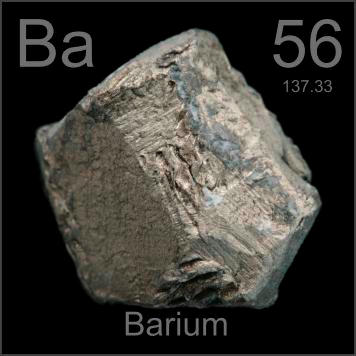
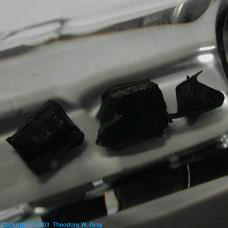
Very pure barium. About the purest barium you'll ever see. Sadly not mine, it was only borrowed to photograph. Source: Anonymous Contributor: Anonymous Acquired: 17 April, 2009 Text Updated: 17 April, 2009 Price: None Size: 0.5" Purity: >99.9% |
||||||||||||||||||
Larger | Spin | 3D |
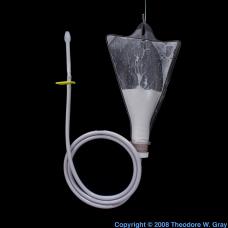
Barium enema, filled. This is a complete barium enema setup, filled with actual barium sulfate suspension. Barium contrast x-rays are used to locate abnormalities in the lower digestive tract. You can also drink the stuff to image the top end. Source: eBay seller bestdeal120 Contributor: Theodore Gray Acquired: 15 April, 2009 Text Updated: 15 April, 2009 Price: $11 Size: 12" Purity: <50% |
||||||||||||||||||
Larger | Spin | 3D |
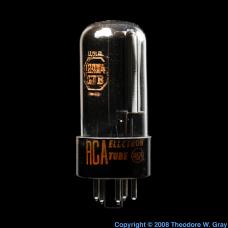
Barium plated getter. The shiny flashing on the inside of this tube is barium metal put there for the purpose of reacting with and thus neutralizing any residual oxygen or moisture left inside during the manufacture of this vacuum tube, or that leaks in over time. Source: Homer Auction Contributor: Theodore Gray Acquired: 11 March, 2009 Text Updated: 17 March, 2009 Price: $0.10 Size: 4" Purity: 99% |
||||||||||||||||||
Larger | Spin | 3D |
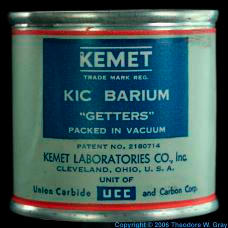
Barium getters. When you need a really good vacuum, and you need it to last a long time, the concept of "air tight" takes on a whole new meaning. For example, glass leaks. Not the seals or joints, but the glass itself. Radio tubes, discharge lamps, and similar applications require a level of perfection in their vacuum and/or inert gas atmospheres that cannot be achieved by any practical container: No matter what you make it out of, it's going to leak too much. The solution is to place inside the sealed chamber a substance, known as a "getter" that absorbs stray traces of moisture, oxygen, or other undesirable contamination that works its way through the glass or metal. Since only a small amount of impurity is going to work its way through, a small amount of getter can keep the system clear for the lifetime of the product. (The getter also clears out any contamination you may have introduced at the beginning, making manufacturing perfection less important.) Barium is a common getter, and this barium getter wire was manufactured in 1941 for use in radio tubes, and has remained sealed in an unopened vacuum can ever since. My theory is that it's because the opening key (not visible in the photos) apparently broke off when someone tried to open it (there is a residual stem where it was attached to the lid). I guess one thing we can be sure of is that the vacuum in that can is really, really clean. Source: Ethan Currens Contributor: Ethan Currens Acquired: 30 October, 2006 Text Updated: 19 November, 2007 Price: Donated Size: 2" Purity: 99% |
||||||||||||||||||
Larger |
Sample from the Everest Set. Up until the early 1990's a company in Russia sold a periodic table collection with element samples. At some point their American distributor sold off the remaining stock to a man who is now selling them on eBay. The samples (except gases) weigh about 0.25 grams each, and the whole set comes in a very nice wooden box with a printed periodic table in the lid. To learn more about the set you can visit my page about element collecting for a general description and information about how to buy one, or you can see photographs of all the samples from the set displayed on my website in a periodic table layout or with bigger pictures in numerical order. Source: Rob Accurso Contributor: Rob Accurso Acquired: 7 February, 2003 Text Updated: 29 January, 2009 Price: Donated Size: 0.2" Purity: >99% |
||||||||||||||||||
Larger |
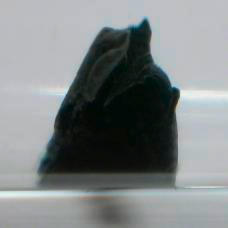
Sample from the RGB Set. The Red Green and Blue company in England sells a very nice element collection in several versions. Max Whitby, the director of the company, very kindly donated a complete set to the periodic table table. To learn more about the set you can visit my page about element collecting for a general description or the company's website which includes many photographs and pricing details. I have two photographs of each sample from the set: One taken by me and one from the company. You can see photographs of all the samples displayed in a periodic table format: my pictures or their pictures. Or you can see both side-by-side with bigger pictures in numerical order. The picture on the left was taken by me. Here is the company's version (there is some variation between sets, so the pictures sometimes show different variations of the samples): 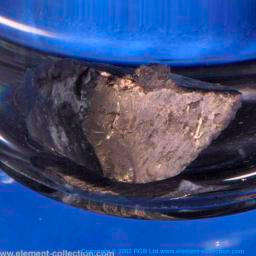 Source: Max Whitby of RGB Contributor: Max Whitby of RGB Acquired: 25 January, 2003 Text Updated: 11 August, 2007 Price: Donated Size: 0.2" Purity: 99.5% |
||||||||||||||||||
Larger | Spin | 3D |
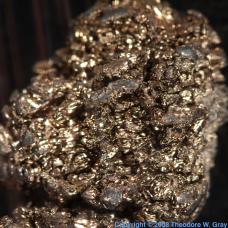
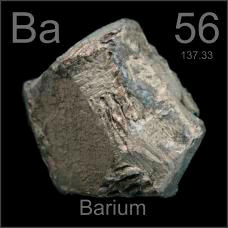
Rough octahedra under oil. I'm not sure what process resulted in these shapes: They look sort of crystal-like in overall shape, but the surface looks more mechanically-formed than crystalline. As an alkali earth, barium is reactive enough that it must be kept under oil to prevent rapid deterioration into barium oxide. I chose this sample to represent its element in my Photographic Periodic Table Poster. The sample photograph includes text exactly as it appears in the poster, which you are encouraged to buy a copy of.  Source: David Franco Contributor: Ed Pegg Jr Acquired: 16 August, 2002 Text Updated: 4 May, 2007 Price: $23 Size: 0.3" Purity: 99.5% |
||||||||||||||||||
Larger | Spin | 3D |
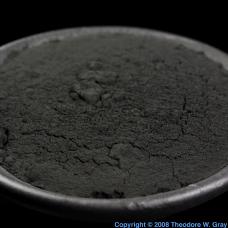
Superconducting powder. YBCO superconducting powder Source: Anonymous Contributor: Theodore Gray Acquired: 2 April, 2009 Text Updated: 17 April, 2009 Price: Anonymous Size: 1" Composition: YBa2Cu3O7 |
||||||||||||||||||
| |||||||||||||||||||
Larger | Spin | 3D |
Barium sulfate suspension. EZEM Barium Sulfate Suspension. Source: eBay seller hcas-granite Contributor: Theodore Gray Acquired: 2 April, 2009 Text Updated: 3 April, 2009 Price: $3 Size: 2" Composition: BaSO4+H2O |
||||||||||||||||||
Larger | Spin | 3D |
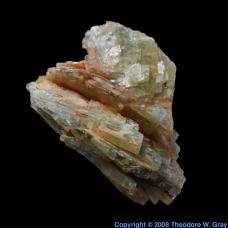
Large barite crystals. Barite from Gilgit, NWFP, Pakistan. Source: eBay seller saltwonders Contributor: Theodore Gray Acquired: 2 April, 2009 Text Updated: 3 April, 2009 Price: $38 Size: 4" Composition: BaSO4 |
||||||||||||||||||
Larger | Spin | 3D |
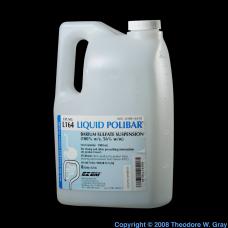
Jug of Polibar barium sulfate. This is an empty jug of Liquid Polibar brand barium sulfate for medical imaging purposes. Basically it's opaque to x-rays, so if you put it into some part of the body, say the intestine, you can tell the exact shape it takes on with a simple x-ray. Filling the intestine is done from both ends, and I'm not sure which end this solution is meant to go in. Hopefully the doctor knows. Source: Dr Chung Contributor: Dr Chung Acquired: 8 February, 2009 Text Updated: 8 February, 2009 Price: Donated Size: 10" Composition: BaSO4 |
||||||||||||||||||
Larger | Spin | 3D |
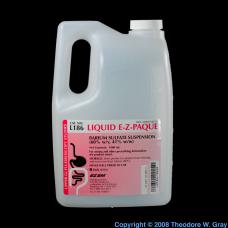
Jug of E-Z-Paque barium sulfate. This is an empty jug of Liquid E-Z-Paque brand barium sulfate for medical imaging purposes. Basically it's opaque to x-rays, so if you put it into some part of the body, say the intestine, you can tell the exact shape it takes on with a simple x-ray. Filling the intestine is done from both ends, and I'm not sure which end this solution is meant to go in. Hopefully the doctor knows. Source: Dr Chung Contributor: Dr Chung Acquired: 8 February, 2009 Text Updated: 8 February, 2009 Price: Donated Size: 10" Composition: BaSO4 |
||||||||||||||||||
Larger | Spin | 3D |
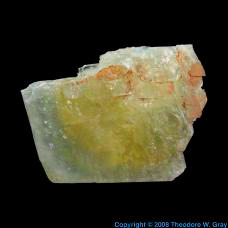
Baryte from Jensan set. This sample represents barium in the "The Grand Tour of the Periodic Table" mineral collection from Jensan Scientifics. Visit my page about element collecting for a general description, or see photographs of all the samples from the set in a periodic table layout or with bigger pictures in numerical order. Source: Jensan Scientifics Contributor: Theodore Gray Acquired: 28 January, 2009 Text Updated: 29 January, 2009 Price: Anonymous Size: 1.5" Composition: BaSO4 |
||||||||||||||||||
Larger | Spin | 3D |
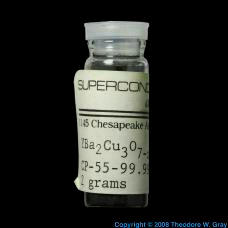
Superconducting powder. This is a small vial of superconducting yttrium-barium-copper-oxide powder. Normally this type of material is seen pressed into pellets that can be used to levitate magnets or perform other superconducting experiments. Background information from the source: Yttrium barium copper oxide was discovered in the late 1980's as being the first known substance to exhibit superconductivity above 77 Kelvin (-321\272F, -195C) outside of a mind-meltingly strong magnetic field. In the grand scheme of things, 77 Kelvin is a completely random value--it has no greater cosmic meaning, it's not an ultimate limit that contradicts some obscure physics theory, nothing like that. Rather, 77 Kelvin is the boiling point of nitrogen. The significance is simply that with the discovery of this material, superconductivity was a phenomenon that suddenly emerged from the realm of "laboratory curiosity" into the wide bright world of "industrially and economically feasible," using liquid nitrogen as a coolant. Previously, liquid hydrogen or liquid helium were necessary to access the temperatures at which superconductivity could be observed (outside of that frog-levitatingly strong magnetic field), both of which are at least an order of magnitude more expensive than liquid nitrogen. Source: Anonymous Contributor: Theodore Gray Acquired: 27 December, 2008 Text Updated: 1 March, 2009 Price: Anonymous Size: 1" Composition: YBa2Cu3O7 |
||||||||||||||||||
Larger | Spin | 3D |
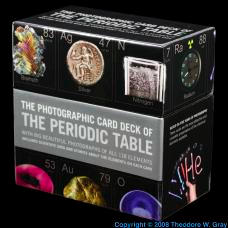
Photo Card Deck of the Elements. In late 2006 I published a photo periodic table and it's been selling well enough to encourage me to make new products. This one is a particularly neat one: A complete card deck of the elements with one big five-inch (12.7cm) square card for every element. If you like this site and all the pictures on it, you'll love this card deck. And of course if you're wondering what pays for all the pictures and the internet bandwidth to let you look at them, the answer is people buying my posters and cards decks. Hint hint. Source: Theodore Gray Contributor: Theodore Gray Acquired: 19 November, 2008 Text Updated: 28 October, 2017 Price: $35 Size: 5" Composition: HHeLiBeBCNOFNeNaMg AlSiPSClArKCaScTiVCrMn FeCoNiCuZnGaGeAsSeBrKr RbSrYZrNbMoTcRuRhPdAg CdInSnSbTeIXeCsBaLaCePr NdPmSmEuGdTbDyHoErTm YbLuHfTaWReOsIrPtAuHgTl PbBiPoAtRnFrRaAcThPaUNp PuAmCmBkCfEsFmMdNoLrRf DbSgBhHsMtDsRgCnNhFlMcLvTsOg |
||||||||||||||||||
Larger | Spin | 3D |
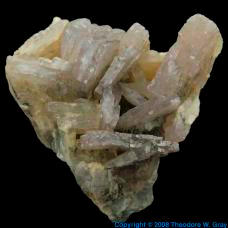
Baryte. Description from the source: Baryte (Ba SO4 orth.), Julcani Mine, Huancavelica, Peru. Tabular crystal cluster. 3,5x3,5x2 cm; 22 g. Source: Simone Citon Contributor: John Gray Acquired: 30 September, 2008 Text Updated: 1 October, 2008 Price: Trade Size: 1.4" Composition: BaSO4 |
||||||||||||||||||
Larger | Spin | 3D |
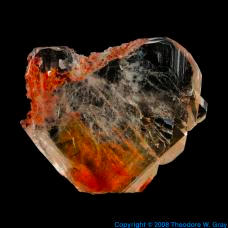
Baryte. Description from the source: Baryte (Ba SO4 orth.), Miraflores Mine, Huanuco, Peru. Small but gem crystals, very nice. 0,8x0,8x0,2 cm; 10 g with box. Source: Simone Citon Contributor: John Gray Acquired: 30 September, 2008 Text Updated: 1 October, 2008 Price: Trade Size: 0.3" Composition: BaSO4 |
||||||||||||||||||
Larger |
Barite. The tag that came with sample reads as follows: Barite - BaSO4, from Sandoval Co., NM.I traded this sample for a few of my strange copper nodules. Source: Calvin Webb Contributor: Calvin Webb Acquired: 1 September, 2003 Price: Donated Size: 1" Composition: BaSO4 |
||||||||||||||||||
Larger | Spin | 3D |
Romanechite from Jensan Set. This sample represents manganese in the "The Grand Tour of the Periodic Table" mineral collection from Jensan Scientifics. Visit my page about element collecting for a general description, or see photographs of all the samples from the set in a periodic table layout or with bigger pictures in numerical order. Source: Jensan Scientifics Contributor: Jensan Scientifics Acquired: 17 March, 2003 Price: Donated Size: 1" Composition: (Ba,H2O)2Mn5O10 |
||||||||||||||||||
| |||||||||||||||||||